Last updated on December 15th, 2025 at 09:06 am
One of the most common challenges in knitting and crochet is when your gauge (tension) doesn’t match the pattern’s requirements.
If your swatch is off, your finished project will be the wrong size!
The only solution isn’t to start over, but to calculate a simple conversion coefficient (or scaling factor) for both your stitches and rows. This allows you to fit your unique tension, scaling every single number in the pattern.
How to Convert Pattern Stitches and Rows When Your Swatch Doesn't Match
Step 1: Compare Your Gauge to the Pattern’s Gauge
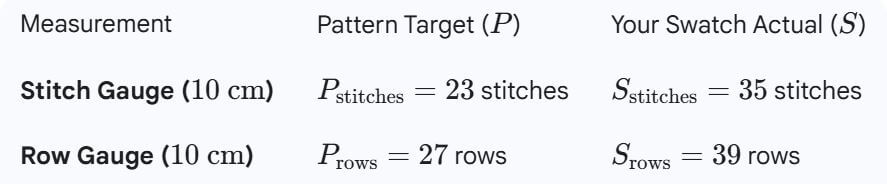
First, you need to measure the difference between the Target Gauge (from the pattern) and your Actual Gauge (from your swatch).
Step 2: Calculate Your Conversion Coefficients
You must calculate two separate factors by dividing your Actual Gauge by the Pattern Gauge. This tells you how much bigger (or smaller) your numbers need to be.
A. The Row Coefficient
This adjusts the vertical length (number of rows).

B. The Stitch Coefficient
This adjusts the horizontal width (number of stitches, increases, and decreases).

Step 3: Apply Coefficients to the Pattern
Now, you will multiply every relevant number in the pattern by the corresponding coefficient.
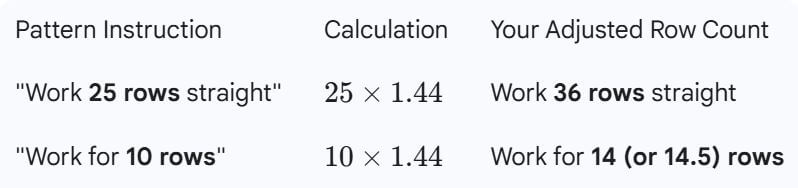
Adjusting Row Counts (Length)
Use C rows for all row counts.
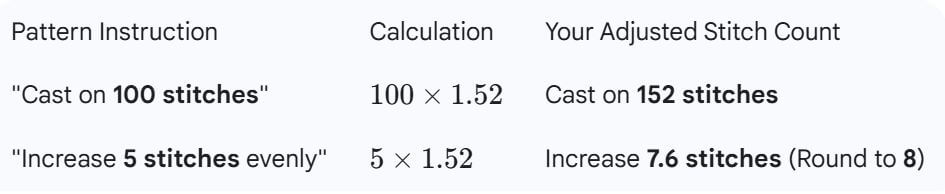
Adjusting Stitch Counts (Width)
Use (C stitches) for all stitch counts, cast-ons, bind-offs, increases, and decreases.
Adjusting Shaping Instructions (The Most Important Part!)
For shaping, you need to adjust both the number of stitches changed and the frequency (rows) of the change.
Original Pattern Example:
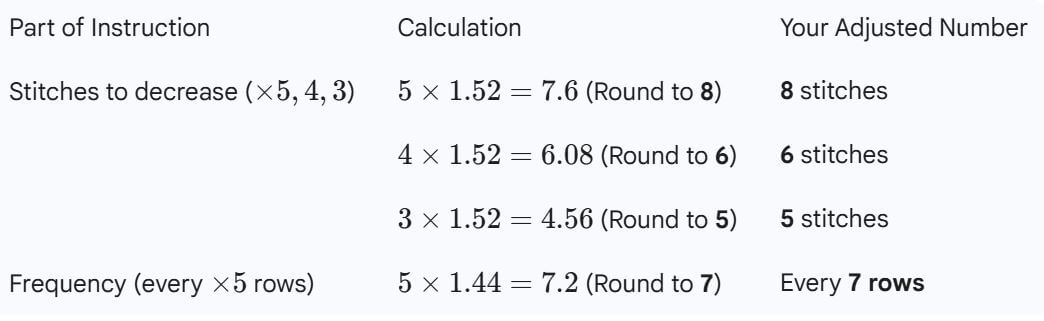
“Decrease 5, 4, and 3 stitches every 5 rows for the armhole.”
Your Adjusted Instruction:
“Decrease 8, 6, and 5 stitches every 7 rows for the armhole.”
🛑 Important Note on Fixed Length Measurements
DO NOT multiply fixed length measurements like cm or inches.
If the pattern says, “Knit until the piece measures 15 cm“, you simply knit until your measuring tape shows 15 cm.
The conversion factor is already baked into your actual gauge, so multiplying a fixed measurement would make your piece the wrong size.
By using this conversion technique, you can use any yarn, any needles, and any pattern, ensuring your finished project always has the proportional shaping and dimensions intended by the designer!
Colorwork: Keep the Pattern Design from Looking Stretched or Squished
- Identify the Target Ratio: Look at the pattern’s required gauge (e.g., 23 stitches and 27 rows per 10 cm. Divide the row count by the stitch count to get the pattern’s proportion ratio.
Pattern Ratio: 27 rows divide by 23 stitches = 1.17
- Identify Your Swatch Ratio: Do the same for your actual swatch (e.g., 35 stitches and 39 rows per 10 cm)
Your Ratio: 39 rows divide by 35 stitches = 1.11
- Find the Best Swatch:
If you have multiple swatches (e.g., Swatch 1 and Swatch 2, perhaps knit with different needles), you want the one where your ratio is closest to the pattern’s ratio.
The simplest way to check this is to see which swatch’s ratio, when compared to the original ratio, is closer to zero (either negative or positive). This swatch will be the closest to the original proportions.
Ready to Level Up Your Skills?
Here are related articles and resources to help you start knitting without patterns: